Showing posts with label Metallurgy. Show all posts

Sunday, 12 January 2014

3D Carbon Goes Metallic

New metallic structure may be stable at ambient temperature and pressure with potential applications in science and technology.
A theoretical, three-dimensional (3D) form of carbon that is metallic under ambient temperature and pressure has been discovered by an international research team.
The findings, which may significantly advance carbon science, are published online this week in the Early Edition of the Proceedings of the National Academy of Sciences.
Carbon science is a field of intense research. Not only does carbon form the chemical basis of life, but it has rich chemistry and physics, making it a target of interest to material scientists. From graphite to diamond to Buckminster fullerenes, nanotubes and graphene, carbon can display in a range of structures.
But the search for a stable three-dimensional form of carbon that is metallic under ambient conditions, including temperature and pressure, has remained an ongoing challenge for scientists in the field.
Researchers from Peking University, Virginia Commonwealth University and Shanghai Institute of Technical Physics employed state-of-the-art theoretical methods to show that it is possible to manipulate carbon to form a three-dimensional metallic phase with interlocking hexagons.
“The interlocking of hexagons provides two unique features – hexagonal arrangement introduces metallic character, and the interlocking form with tetrahedral bonding guarantees stability,” said co-lead investigator Puru Jena, Ph.D., distinguished professor of physics in the VCU College of Humanities and Sciences.
The right combination of these properties could one day be applied to a variety of technologies.
“Unlike high-pressure techniques that require three terapascals of pressure to make carbon metallic, the studied structures are stable at ambient conditions and may be synthesized using benzene or polyacenes molecules,” said co-lead investigator Qian Wang, Ph.D., who holds a professor position at Peking University and an adjunct faculty position at VCU.
“The new metallic carbon structures may have important applications in lightweight metals for space applications, catalysis and in devices showing negative differential resistance or superconductivity,” Wang said.
According to Jena, the team is still early in its discovery process, but hope that these findings may move the work from theory to the experimental phase

Wednesday, 25 September 2013

Historical Aspects of Metallurgy

Materials are probably more deep-seated in our culture than most of us realize.
Transportation, housing, clothing, communication, recreation, and food production—
virtually every segment of our everyday lives is influenced to one degree or another
by materials. Historically, the development and advancement of societies have been
intimately tied to the members’ ability to produce and manipulate materials to fill
their needs. In fact, early civilizations have been designated by the level of their
materials development (Stone Age, Bronze Age, Iron Age).

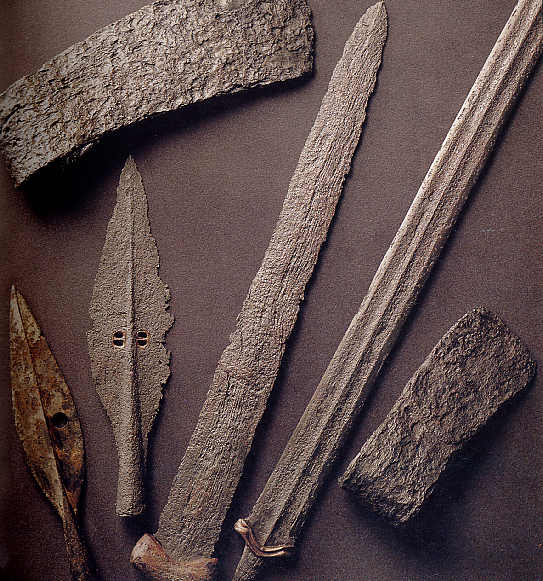
Some Bronze Age Weapons

The earliest humans had access to only a very limited number of materials,
those that occur naturally: stone, wood, clay, skins, and so on.With time they discovered
techniques for producing materials that had properties superior to those
of the natural ones; these new materials included pottery and various metals. Furthermore,
it was discovered that the properties of a material could be altered by
heat treatments and by the addition of other substances. At this point, materials utilization
was totally a selection process that involved deciding from a given, rather
limited set of materials the one best suited for an application by virtue of its characteristics.
It was not until relatively recent times that scientists came to understand
the relationships between the structural elements of materials and their properties.
This knowledge, acquired over approximately the past 100 years, has empowered
them to fashion, to a large degree, the characteristics of materials.Thus, tens of thousands
of different materials have evolved with rather specialized characteristics that
meet the needs of our modern and complex society; these include metals, plastics,
glasses, and fibers.

The development of many technologies that make our existence so comfortable
has been intimately associated with the accessibility of suitable materials.
An advancement in the understanding of a material type is often the forerunner
to the stepwise progression of a technology. For example, automobiles
would not have been possible without the availability of inexpensive steel or
some other comparable substitute. In our contemporary era, sophisticated electronic
devices rely on components that are made from what are called semiconducting
materials.