Showing posts with label Printers. Show all posts

Wednesday, 10 December 2014

Hacking into 3D Printers

Now a days, new 3D printers seem to be rolling out daily or at least the trends at the crowdsourcing sites indicate so. But how many of these campaigns will finally release a product in the market and will deliver to the mark at the claims made in these campaigns.
May be more than half, but with the expiry of lot important patents in the coming year this trend is going to go up on the rise with more new jargon and technologies being used in their crowdsourcing videos. The promise will be of 10x faster and 50x better technology.
Thus, we have decided to decipher these technologies for you and are going to post each week on a new 3D printing technology, with all what one needs to know to start a crowdsourcing campaign of his own or to decide whether to invest in the technology displayed in such campaigns.
Let us know the technology you want to be hacked in the comments

Tuesday, 9 December 2014

The Science behind HP's Fusion Jet 3D printer

HP has big claims and bigger hope for it's Fusion Jet 3D printer with which it entered the 3D printing space. HP or Hewlett Packard has made a fortune in the 2D printing business with its Inkjet and Laser printers, but never entered the 3D printing space, though the technology has been there since 1939. With the launch of its Fusion Jet 3D printer it made it clear that HP's technology in 2D space can be applied to the 3D realm as well.
The technology behind HP's fast and multi-color printing 3D fusion jet printer is based on a old IP that they hold for thermal inkjet printing and you can find the same technology being used in many of HP's 2D printers as well. They are a lot different from the Stereolithography or Material extrusion methods but quite similar to the laser sintering method without the laser.
Laser sintering method spreads a layer of metal powder which is then sintered by precision lasers and then another layer of powder is spread onto it. The next layer when sintered is fused to the lower layer. This curing of material powder is attained in the fusion jet without the laser but a heat source and chemicals.
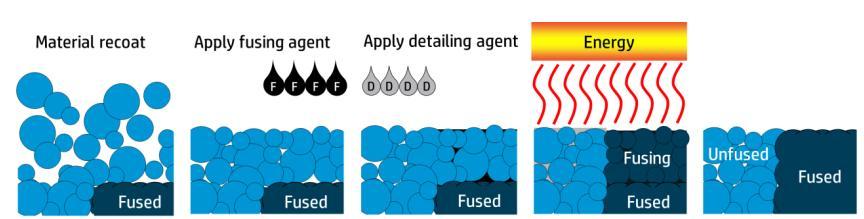
The Fusion jet spreads one layer of material and then a print head (thermal inkjet array) is passed onto it which prints chemicals across the entire print area. The print head has a dense no of nozzles per inch, with the total no. of nozzles on the entire print head being close to 30,000. This provides the highest resolution in 3D printing industry of 20 micron precision.
They use two types of chemicals - fusing agent and detailing agent with an option for a coloring agent. When they are heated by a energy source the fusing agent fuses the material while the detailing agent is used in areas where the effect of fusing agent has to be either removed or amplified. This allows to have nice surface finish with curves and sharp edges. This also allows to have a texture on the printed surface. The nozzles are capable of printing 3 million drops per second of such agents making it 10x more faster than any technology available so far. 

The major advantage of this technology is we can control the property of the printed mode with using different combination of agents and materials, also the ability of precisely print one voxel (volumetric pixel) with HP's proven technology in 2D printing allows you to print in such high defination that you are used to seeing in 2D prints from HP printers.
HP is right to making the claims it has for the printer but will need some time to polish the technology in 3D printing. But use of technology available in your normal 2D printer has allowed it to scale it both up and down and provide faster and better 3D printing at a affordable cost.
Have a look at what HP has to say about its Fusion Jet Printers (Yeah it does seem a bit far fetched but with the technology HP's using it is not that far away):

Monday, 8 December 2014

Now Royal Mail offers to 3D print gifts before shipping them


Now Royal mail offers you to 3D print gift items at their post office before mailing them. UK's Royal Mail has teamed up with iMakr on trial to allow users to either 3D print your own creations or select something from readymade designs before shipping them.
The trial is now available only at Royal Mail's New Cavendish Street office in London, and depending on its success it may soon be available at other Royal Mail's office.
So what will you 3D print to gift? Let us know in your comments below.

Saturday, 6 December 2014

With this cartridge, you can print a Solid Oxide Fuel Cell

Photo: Shah lab at Northwestern University

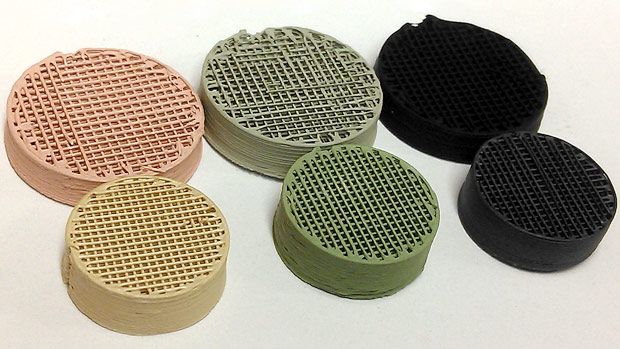
The mixture of ceramic, binder and solvent that evaporates at different rate allows you now to 3D print a solid oxide fuel cell. This ink is developed by researchers at Northwestern University. Prof. Ramille Shah is the man behind the ink, which allows 3D printing of all individual components of a fuel cell - anode, cathode, electrolyte and interconnects.
This work was shown at the Material Research Society fall meeting at Boston this week by Adam Jakus, a Ph.D. at Shah's lab. The use of 3D printing has allowed them to print in new shapes and designs which the conventional methods don't allow. They have been able to generate really dense packed particle structure in the 3D printed models. Moreover, 3D printing allows them to use new designs which might increase the surface area and hence the transport of charge or increase the efficiency. This can be one of the breakthroughs in use solid oxide fuel cell to convert gas into electricity.

Also, the team has developed a ink to 3D print GRAPHENE!

Thursday, 27 November 2014

3D Printing Electronics

One of most lacking thing in 3D printing was the ability to print circuit embedded designs. But now there is a solution to that - Functionalise. It is a startup by a software engineer who faced the same problem and ended up making a make shift nano material lab in his house.
The solution that Functionalise offers are plastics with different conductivity. Thus, is able to create a circuit without the need to have metal components (this still remains a problem - to print metal and plastic together). Here is their kickstarter video:

The other attempts in this field includes NanoDimension, which just received $500K Grant to develop a 3D Printer to print circuits. They are working not on printing the complete structure with the circuit inside but just on printing the PCB's. 


If both these projects go as planned, we might soon no longer need to assemble devices. We will be able to just print a watch or display or maybe a iPhone. 

Monday, 24 November 2014

3D Printing in a Nutshell

Here's a introduction to 3D Printing in a nutshell. Lets watch a 3D Printer in action: 


This video by 16x9, covers almost all of the things you need to know about 3D printing. The most interesting thing about 3D printing is that there is no end to what you can print. We are printing tissues, food items, metal pieces and even guns. 
What lies ahead? There are currently research going on to print electronics, various types of metals, and ability to print multiple materials in the same item, instead of printing them separately and then assembling them.

The Science Behind 3D Printing


The science behind 3D printers is really old. It has been in existence since 1984, but recently with the innovation in field of IT technology and material science, it has become cheaper, easily accessible and cost effective. Most of the 3D printers work on a bottom's up approach and deposit a layer of plastic, then another layer on top and keep on doing that till they get the finished product. This is how 3D printing of plastic parts is done and requires a hot head to melt plastic and deposit it, like the ink heads of the old inkjet printers. 

Another technique is printing resin, it uses LED's to print them. So, its more easy to maintain, gives you a lot more print and the product are almost as strong as those of the plastic printing. Lets see a video by FormLabs, one of the innovators in field of using resin for printing: 

But when it comes to printing metal you need to deal with really high temperatures, and instead of pouring in molten metal or a shooting a jet of liquid metal, its preferred to melt a layer of powdered metal, so that they are bonded. This is known as sintering, and is usually done by high energy laser. But still this method doesn't gives you the same amount of strength as a cast structure would have provided. 

So, if you can find out a way to 3D print metals with the strength that of a cast structure or control the microstructural properties of the product, maybe print in different part with different alloy composition - you will be on your way to become a billionaire. I hope this has provided you all with a basic insight about 3D printing and the enormous potential it has. 

Follow us for more news of Material Science and 3D Printing.

New Segment on 3D Printers

Hey Everyone,
After a long break, we are break and this time with a special segment on 3D Printers. 3D Printers is one of the hottest topics in innovation today. No other technology is developing at a greater pace and affecting so many lives as 3D Printing. It has truly brought innovation to your desktops.
In the segment we will be following all the updates on this front from Kickstarter campaigns to releases from big corporations like HP (it claims to have made the first multi-material 3D Printer) and all the promising research work in this field.
For those of you who do not know about 3D Printers - it's a rapid Prototyping technique which allows you to print any shape or design from a CAD file into reality. Most of the current 3D printers print only in plastic or Resin. They deposit layer of plastic from a nozzle similar to the inkjet printers. Then a new layer is deposited on the previous one. In this manner, layer by layer the whole structure takes form.
Here are a few examples of what you can make with a 3D Printer:
Need a gear, just print it. Need a assembly of gears, just print it and it will work. 
Yes, you can even print apparels from a 3D printers
Art work? Now, only your imagination and CAD abilities are the limit

Don't forget to follow us, for the latest news in the field of Material Science Research and 3D printers.